
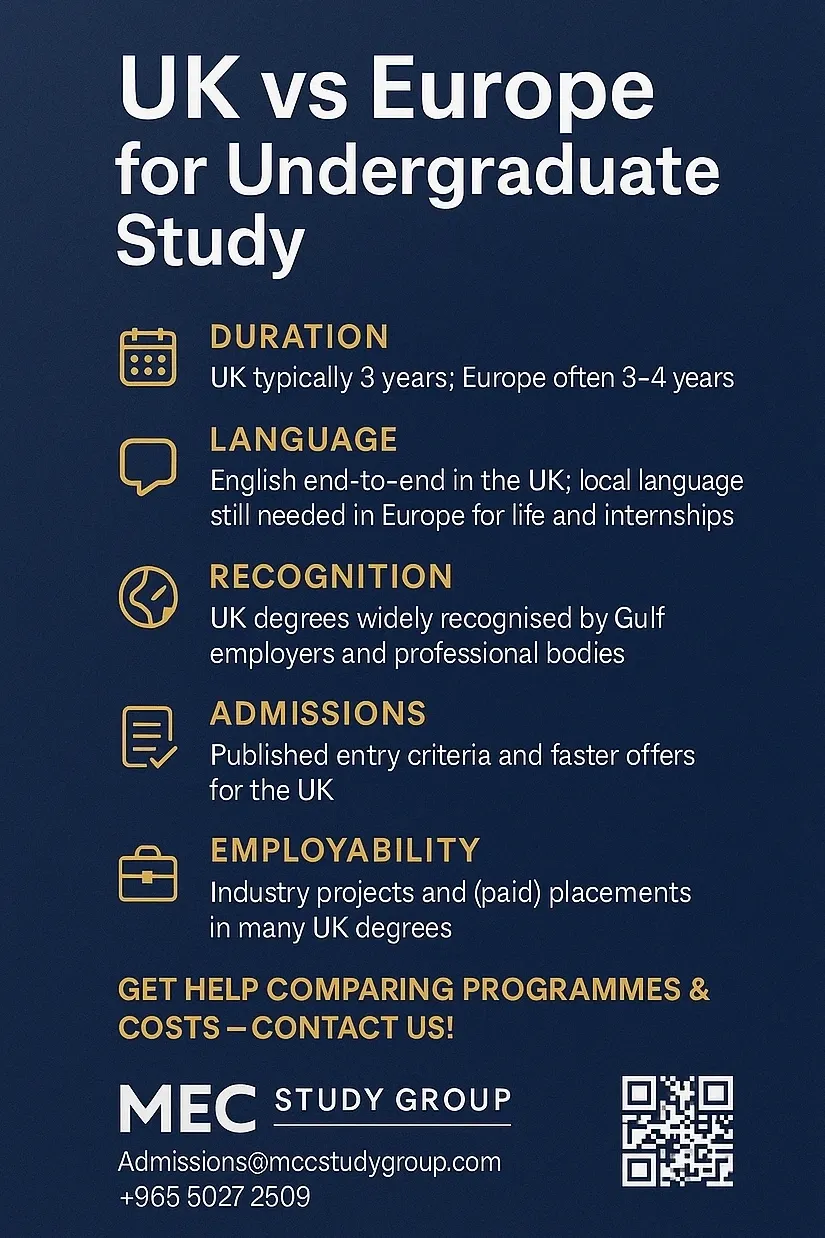
UK vs Europe for Undergraduate Study: Cost, Speed, Language & CV
Choosing where to do your Bachelor’s isn’t just “tuition vs tuition.” The smarter comparison is total cost of study (TCO), time-to-degree, language friction, and how clearly your degree reads on a CV in Kuwait, KSA, UAE, and worldwide. Here’s a clear, UG-only guide you can share with families and schools.
TL;DR (Undergrad)
- UK = typically 3 years (or 4 with a paid “sandwich” placement). Many European options are 3–4 years.
- English end-to-end in the UK (teaching, admin, careers). In Europe, lots of English-taught courses exist, but daily life/internships may still need the local language.
- Global recognition: UK university brands and degree formats are instantly understood by employers and professional bodies across the Gulf and beyond.
- Admissions clarity & speed: UK entries are generally faster and more standardised; Europe varies by country.
1) Duration, Cost & ROI (for families)
Time is money. A shorter degree reduces both living costs and the time before you start earning.
- UK Bachelor’s: Most are 3 years. Add +1 year if you choose a placement/sandwich year (often paid).
- Europe: Many countries are 3 years, some are 4. Check the country norms carefully.
Why this matters
- Living costs are paid every year you study.
- A placement year in the UK can be paid, offsetting costs and strengthening your CV.
Illustrative TCO example (outside London):
UK 3-year route: Tuition (~£14k–£20k per year) + Living (~£10k–£14k per year) × 3.Europe 3–4 year route: Annual tuition varies, but add a potential extra year of living if it’s a 4-year model, plus language costs.
Compare total years × living costs, not just tuition.
2) Language & Day-to-Day Ease
- UK: Fully English-medium. No hidden language curve.
- Europe: English-taught programmes exist, but local language is often needed for life and internships.
Tip for Gulf students: UK is smoother for English-only focus. Europe works well if you plan to learn the language early.
3) Recognition & CV Strength
- UK degrees are widely recognised and easy for employers to evaluate.
- Strong industry links: projects, placements, career fairs.
- Aligned with professional bodies in regulated careers.
4) Admissions & Offers
UK:
- Clear entry criteria
- Personal Statement + reference
- Foundation / IY1 options
- Fast decisions (Sept & Jan intakes)
Europe:
- Varies by country/university
- May require tests, blocked accounts, recognition steps
- Less uniform timelines
5) Employability
- UK:
- Placement year (often paid)
- Career centres: CVs, interviews, fairs
- Alumni networks
- Europe:
- Strong in niche fields
- Language mastery boosts access
6) Popular Curricula & UK Pathways
(Indicative only)
- A-Levels / IB: Direct entry
- CBSE: Often direct
- American Diploma: May need AP/SAT
- Mixed profiles: Foundation / IY1
7) Family Checklist
- Decide country, duration, language
- Compare TCO
- Shortlist 5–7 universities
- Apply early
- Plan internships
FAQs
Is Europe cheaper?
Not always—consider total cost.
UK degree recognised?
Yes—widely accepted in the Gulf.
Need foundation?
Depends on grades and curriculum.
Placement year worth it?
Yes—often paid and boosts employability.
Bottom Line
- UK: Best for simplicity, recognition, career support
- Europe: Great if you commit to language + longer planning
Next Steps
- Map profile → entry route
- Build shortlist + TCO
- Prepare Personal Statement & CV
- Plan placements/internships